
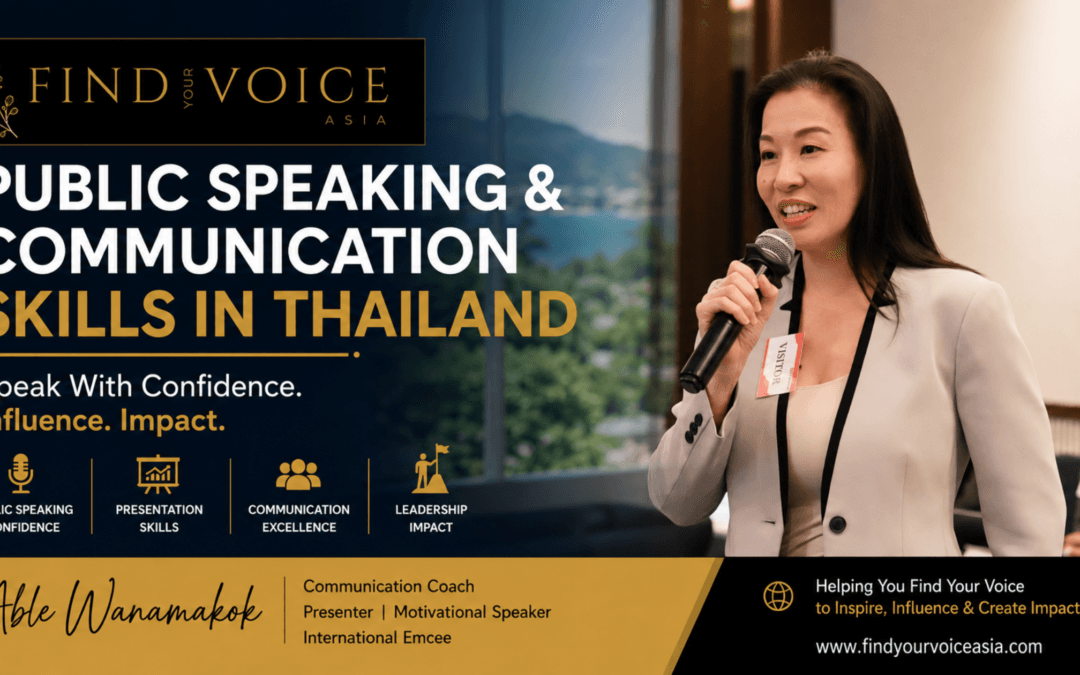
Public speaking and communication skills shape how professionals are perceived, trusted, and remembered — whether on stage, in a boardroom, or in an international negotiation. In Thailand’s fast-growing business hubs like Phuket and Bangkok, the ability to communicate clearly and confidently has become a genuine career advantage. Find Your Voice Asia (FYVA) helps individuals build that confidence through personalized coaching, led by communication coach and international emcee Able Wanamakok.
Key Takeaways
- Public speaking isn’t limited to formal stages — it includes meetings, pitches, interviews, and everyday professional conversations.
- Confidence in speaking is built through preparation, structure, and repeated practice, not raw talent alone.
- Presentation skills, communication skills, and public speaking are related but distinct — each needs slightly different techniques.
- Thailand’s growing international business environment makes English communication confidence increasingly valuable.
- Coaching and structured practice accelerate improvement far faster than self-study alone.
What Is Public Speaking and Why Does It Matter in Thailand?
Public speaking is the practice of communicating a message clearly and persuasively to an audience — whether that audience is ten colleagues in a meeting room or a few hundred people at a conference. At its core, it combines clarity of thought, vocal delivery, and audience awareness.
In Thailand, and particularly in cosmopolitan areas like Phuket, public speaking matters because professional life increasingly happens across cultures and languages. Strong public speaking supports:
- Confidence — the ability to speak without being derailed by nerves.
- Clarity — organizing thoughts so a message lands the first time it’s heard.
- Audience connection — reading a room and adjusting tone or pace accordingly.
- Credibility — sounding prepared and in command of a subject.
- Leadership — the expectation that senior roles communicate direction with confidence.
None of these are innate talents reserved for a few naturally gifted speakers. They develop through structure, feedback, and practice — exactly why public speaking coaching exists as a profession.
Why Public Speaking and Communication Skills Matter for Professionals
Communication confidence affects far more job categories than most people assume — not only keynote speakers or executives giving quarterly updates.
- Executives and managers rely on clear communication to align teams without ambiguity.
- Entrepreneurs pitch ideas and negotiate, often with audiences who don’t share their first language.
- Sales professionals build rapport quickly and present value under time pressure.
- Educators and trainers hold attention and explain complex ideas accessibly.
- Aspiring speakers and presenters need a foundation before moving into more visible roles.
Public Speaking vs Communication Skills vs Presentation Skills
These terms are often used interchangeably, but they describe different (if overlapping) skill sets.
| Skill Area | What It Focuses On | Typical Situations |
|---|---|---|
| Public Speaking | Delivering a message to an audience with confidence and clarity | Conferences, speeches, panels, large meetings |
| Communication Skills | Exchanging ideas clearly, listening well, building understanding | Daily conversations, negotiations, team management |
| Presentation Skills | Structuring and delivering material to inform or persuade | Business pitches, slide decks, product demos |
| Leadership Communication | Communicating direction and vision to inspire action | Team meetings, organizational updates, change management |
| Executive Presence | The overall impression of confidence and composure a person projects | Client meetings, interviews, high-stakes negotiations |
Public speaking is really a specific application of communication skills — one built around addressing an audience directly. Presentation skills borrow from both, adding structure and often visual material.
How to Become a More Confident Public Speaker
- Prepare deliberately. Know your core message before worrying about delivery.
- Structure the message. A simple opening–body–close keeps speaker and audience oriented.
- Use storytelling. Concrete examples make abstract ideas memorable.
- Control pace and pauses. Deliberate pauses signal control, not nervousness.
- Work on vocal variety. Tone and emphasis keep an audience engaged.
- Use body language intentionally. Posture and eye contact reinforce the message.
- Practice audience engagement. Questions and eye contact prevent a talk feeling like a monologue.
- Address nervousness directly. The goal is managing nerves, not eliminating them.
- Seek feedback and repeat. Improvement compounds through practice and honest feedback.
How to Improve Presentation Skills in Thailand
Presentation skills sit at the intersection of structure, delivery, and audience management — and matter enormously in Thailand’s business environment, where presentations often serve mixed audiences of Thai and international stakeholders.
- Presentation structure — a clear opening, logical body, and reinforcing close.
- A strong opening — the first thirty seconds set the tone.
- Storytelling within data — numbers land better inside a narrative.
- Visual communication — slides should support the spoken message, not replace it.
- Voice and delivery — pacing and clarity matter more than accent or vocabulary.
- Handling questions — composed answers shape an audience’s overall impression.
- Presenting in English — a distinct skill, separate from fluency itself.
FYVA’s Presenter Coaching work focuses specifically on this combination of voice, tone, pace, and body language — the mechanics that separate a competent presenter from a genuinely compelling one.
How Communication Skills Help Leaders and Entrepreneurs
Leadership communication is less about eloquence and more about clarity, consistency, and credibility. For entrepreneurs and business leaders in Thailand’s international environment, strong communication supports persuasion, credibility, influence, team clarity across language and cultural differences, and stronger client relationships. Executive presence is frequently the product of exactly these habits, practiced consistently over time.
How to Improve Public Speaking Confidence in Phuket
Phuket’s business community mixes local entrepreneurs, international residents, and professionals across hospitality, real estate, and wellness — a mix that makes communication confidence especially visible. Building it typically benefits from structured coaching, workshops and group practice, personalized feedback, rehearsing real professional scenarios, and exposure to international audiences.
How Find Your Voice Asia Helps People Find Their Voice
Find Your Voice Asia provides communication coaching built around helping individuals communicate more honestly, clearly, and confidently — both professionally and in everyday interactions. Rather than treating public speaking as a purely technical skill, FYVA connects communication confidence to a person’s own authentic voice, helping clients sound like themselves rather than an imitation of a “typical” polished speaker.
Meet Able Wanamakok: Communication Coach, Presenter, Speaker and International Emcee
Able Wanamakok’s communication career reflects a path that began in broadcasting and news presenting before expanding into international event hosting, motivational speaking, and communication coaching. That broadcasting background — where clarity, pacing, and composure under pressure are non-negotiable — has shaped an approach to coaching that emphasizes practical delivery skills over theory.
Since relocating to Phuket, Able has built experience working with varied audiences and cultural contexts, a natural extension of years spent as an international emcee hosting events across different countries. This breadth of experience — moving between broadcast presenting, live event hosting, motivational speaking, and one-on-one coaching — gives Able a grounded, practice-based perspective on what actually helps someone communicate more effectively.
Gulf Prime Magazine’s profile on Able Wanamakok’s journey offers additional third-party context, tracing the connections between broadcasting, public speaking, communication coaching, and Able’s wider work in Thailand’s creative and events industry.
From Public Speaking to Professional Presentation
Public speaking, presenting, and emceeing sit on a connected spectrum — the same underlying skills apply, but each context adjusts how they’re used.
- Presenting — structured, often visual, material for a defined audience, covered by FYVA’s Presenter Coaching.
- Speaking — everything from internal meetings to keynote addresses.
- Emceeing — guiding a live event in real time, covered by FYVA’s work in emceeing and event hosting across Asia.
- Media and leadership communication — extending these skills into broadcast or organizational settings.
When Should You Consider a Public Speaking or Communication Coach?
- Persistent fear or nervousness before speaking, even in low-stakes settings.
- Difficulty organizing ideas clearly, leading to rambling delivery.
- Feedback that presentations feel flat, unclear, or hard to follow.
- A lack of confidence speaking to senior executives, clients, or large groups.
- An upcoming high-stakes presentation, pitch, or speech.
- Genuine interest in developing toward public-facing roles, such as presenting or emceeing.
For anyone recognizing these patterns, Find Your Voice Asia’s coaching approach is built around identifying the individual habits holding a person back and working through them systematically.
For event organizers who also need to discover verified performers, MCs and other entertainment talent in Thailand, Artist Hub Thailand provides a separate marketplace directory connected to the wider event ecosystem — distinct from FYVA’s coaching services.
Frequently Asked Questions
Structure your message, then practice delivery with real audiences and honest feedback — ideally through coaching like FYVA’s, tailored to Thailand’s mixed local-and-international settings.
Find Your Voice Asia, led by communication coach Able Wanamakok, offers personalized coaching in Phuket for professionals working across cultures and languages.
Confidence comes from rehearsing real situations and getting delivery feedback, not vocabulary study alone — coaching accelerates this considerably.
Public speaking is addressing an audience with confidence and clarity; presentation skills add structure and visual material to inform or persuade.
Combine structured practice on specific habits — pacing, filler words, clarity — with honest feedback, ideally rehearsing an actual upcoming pitch or presentation.
Conclusion
Better communication isn’t about speaking more — it’s about speaking clearly, confidently, authentically, and with purpose. Able Wanamakok’s background across broadcasting, international emceeing, motivational speaking, and communication coaching informs a practical, experience-based approach at Find Your Voice Asia — helping professionals in Phuket, Thailand, and beyond find a more confident and authentic communication style.
Ready to speak with more clarity, confidence, and impact?

Great post, I really had a great time reading it. Your writing style is extremely captivating and your insights are…
Wow amazing post! I totally agreed, personally I think traveling allow me to wander and get lost which allowing me…